SOCAL RAGDOLLS JOURNAL
From Riverside to Ragdoll: The California Story Behind the Breed
The Ragdoll is a distinctly California-born breed. Discover the story of Ann Baker, Josephine, the early foundation cats, and how a Riverside breeding program became a beloved international cat breed.
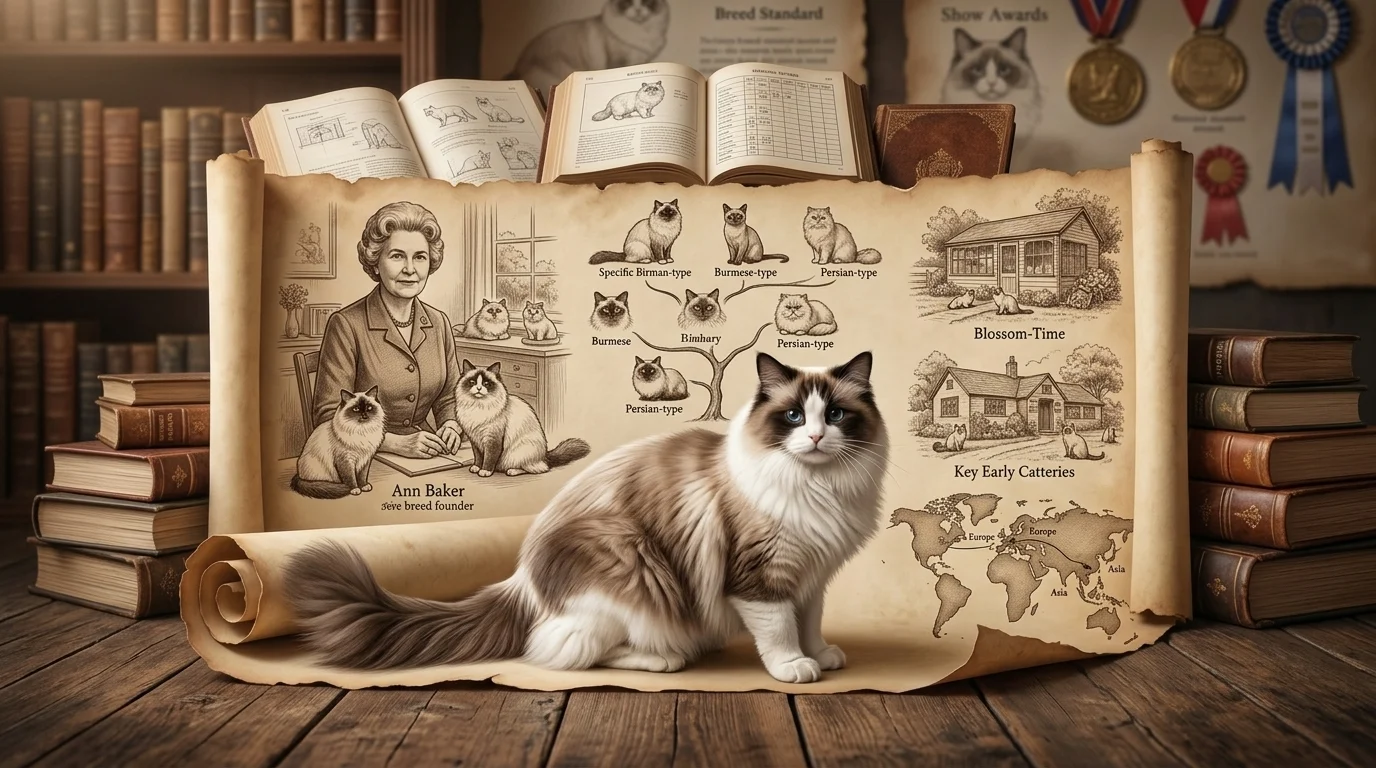
There is something especially fitting about raising Ragdolls in Southern California: the Ragdoll is, in a very real sense, a California-born cat breed.
Unlike breeds whose beginnings disappear into centuries of folklore, the history of the Ragdoll is comparatively recent and unusually well connected to a place. The story begins in the early 1960s in Riverside, California, with breeder Ann Baker and a white longhaired cat named Josephine.
Josephine and the beginning of the Ragdoll
Cat Fanciers’ Association breed history identifies Josephine as a white domestic longhair carrying the colorpoint gene. Ann Baker became interested in Josephine’s descendants and selectively bred cats that displayed the appearance and temperament she wanted to develop.
The International Cat Association’s breed history also names a seal-point mitted male called Daddy Warbucks and a solid black cat called Blackie among the early foundation cats. Daddy Warbucks was bred within Josephine’s family line, helping establish the cats from which the modern breed developed.
This is an important part of the story: the Ragdoll was not an ancient natural breed that was simply discovered. It was deliberately developed through selective breeding of domestic cats for a particular combination of temperament, body type, coat, color, and pattern.
Why are they called “Ragdolls”?
Ann Baker associated Josephine’s descendants with an unusually relaxed temperament and said some became limp when held, like a child’s cloth rag doll. That story gave the breed its memorable name.
The name should not be treated as a promise that every Ragdoll will go completely limp in someone’s arms. Modern breed information notes that this behavior is not typical of every Ragdoll. What has endured far more consistently is the breed’s reputation for being affectionate, calm, sociable, and people-oriented.
The myths are part of the history too
Early Ragdoll history includes some colorful claims. Baker said Josephine’s temperament changed after treatment following an automobile accident and suggested her genes had somehow been altered. The story is still repeated as part of Ragdoll folklore, but it is not a scientific explanation for the breed.
The straightforward explanation is selective breeding: breeders chose cats with the physical and behavioral traits they wanted and reproduced those traits over successive generations.
Denny and Laura Dayton helped move the breed forward
As the breeding program grew, disagreements developed between Baker and some of the breeders associated with her program. Denny and Laura Dayton were among the breeders who separated from Baker and became important in developing the Ragdoll into a standardized breed recognized by major cat registries.
Their work helped move the Ragdoll from one breeder’s closely controlled program toward the organized breed community that exists today.
Recognition by major cat organizations
When The International Cat Association began in 1979, the Ragdoll was accepted for championship competition. The Cat Fanciers’ Association accepted Ragdolls for registration in 1993 and advanced the breed to championship status in 2000.
In only a few decades, cats descended from a small California breeding program had become an internationally recognized pedigree breed.
What defines a Ragdoll today?
The modern Ragdoll is a medium-to-large, moderately longhaired, blue-eyed pointed cat. The body is lighter than the face, ears, legs, and tail because of the colorpoint gene, while white spotting creates the dramatic bicolor and mitted appearances many people immediately associate with the breed.
Ragdolls are slow to mature. Their color, coat, body size, and overall appearance continue developing well beyond kittenhood. That is one reason a young Ragdoll can look surprisingly different from the adult they eventually become.
The temperament became just as important as the look
The physical standard matters, but the Ragdoll’s temperament is arguably what made the breed famous. Major breed organizations describe Ragdolls as gentle, loving, calm, sociable, intelligent, and generally tolerant. Many enjoy following people around the home, greeting family members, playing fetch, or simply settling nearby.
That does not mean every Ragdoll has the same personality. Genetics, early socialization, environment, handling, and individual temperament all contribute to the cat you ultimately live with. A pedigree describes a breed; it does not erase individuality.
A dramatic coat with a practical texture
Ragdolls look extremely fluffy, but their semi-long coat is characterized by abundant guard hairs and relatively little dense woolly undercoat. Regular combing is still important, especially during seasonal shedding and anywhere friction can create tangles, but the coat can be more manageable than its luxurious appearance suggests.
The vivid blue eyes, pointed coloring, substantial body, and soft coat create the unmistakable Ragdoll look, while the gentle personality completes the package.
A Southern California original with a worldwide following
Today, Ragdolls are loved far beyond California, but their history still leads back to Riverside. Josephine, Ann Baker’s breeding program, the early foundation cats, and the breeders who later helped standardize the breed all contributed to a cat that became recognizable around the world.
For us at SoCal Ragdolls, that local history makes the breed especially meaningful. Raising purebred Ragdoll kittens in Southern California means continuing the story in the same region where it began more than six decades ago.
The history continues with every new family
The Ragdoll’s history is not only a story about breed standards and registration dates. It is also a story about why people kept choosing these cats: their striking appearance, relaxed presence, and deep appeal as companions.
From a white longhaired cat named Josephine in Riverside to families welcoming Ragdolls into homes around the world, it is a remarkably modern success story—and one that started right here in Southern California.