SOCAL RAGDOLLS JOURNAL
Ragdoll Cat Colors and Patterns: A Complete Guide to Every Beautiful Variation
Explore Ragdoll cat colors including seal, blue, chocolate, lilac, red and cream, plus bicolor, mitted, colorpoint, lynx and tortie patterns. Learn the difference between Blue Bicolor and Seal Bicolor Ragdolls.
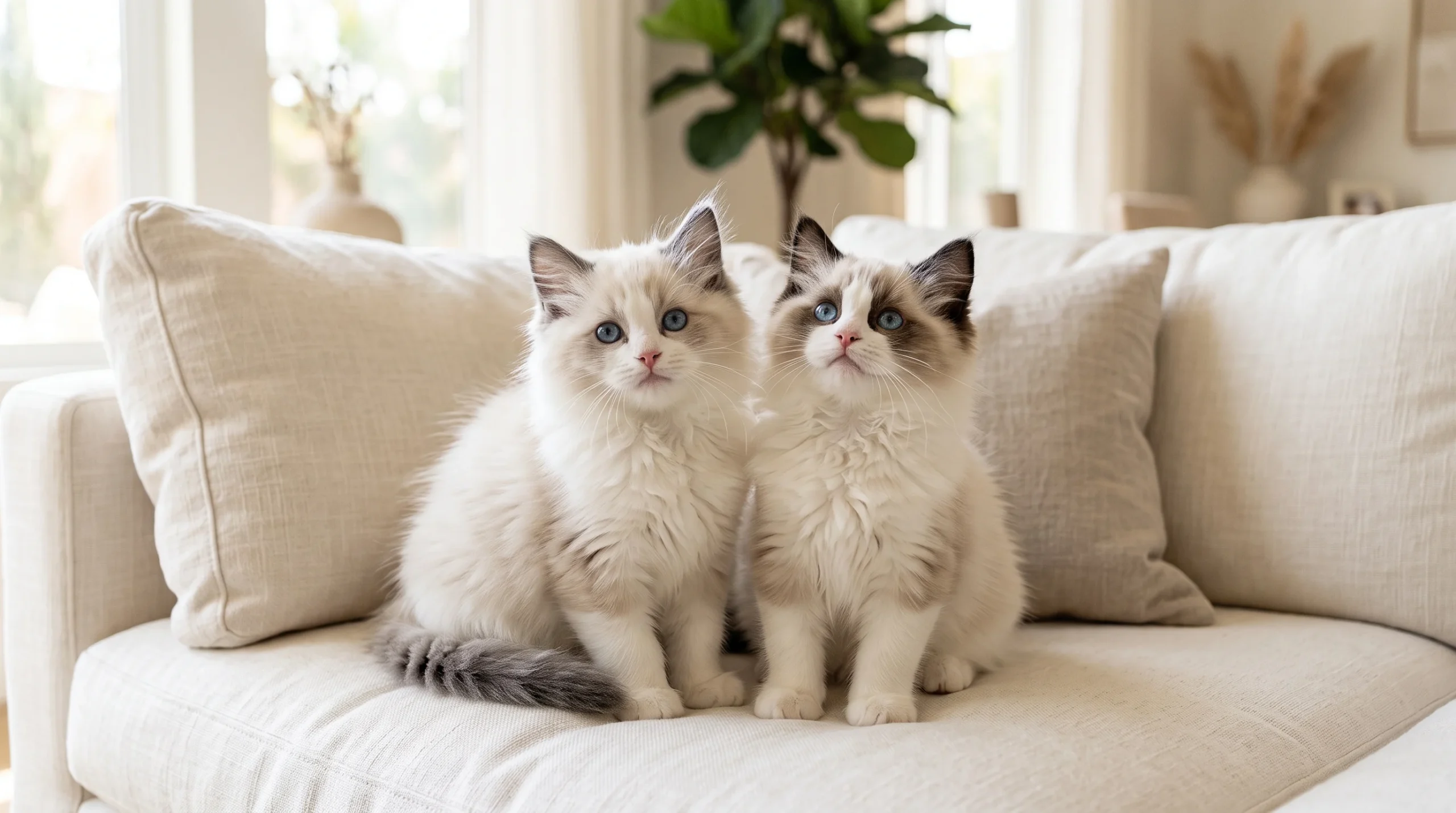
One of the most exciting parts of meeting a Ragdoll kitten is discovering the remarkable variety of colors and markings within the breed. Some Ragdolls have deep chocolate-brown ears and tails, others have cool blue-gray points, and others wear the unmistakable white inverted V of a bicolor face. Their coats can look very different, even though they share the same affectionate breed heritage.
If you have been searching for Ragdoll kitten colors, or wondering about the difference between a Blue Bicolor Ragdoll and a Seal Bicolor Ragdoll, this guide will help you understand the terminology, recognize the patterns, and know what may change as your kitten grows.
First, understand the difference between color and pattern
When breeders describe a Ragdoll as “seal bicolor” or “blue mitted,” they are describing two separate things. Color identifies the pigment seen most clearly on the points—the ears, face, legs, and tail. Pattern describes where that color and any white markings appear.
For example, a seal point and a seal bicolor share the same basic seal-brown pigment, but the bicolor has much more white, including a characteristic white inverted V on the face. Likewise, “blue” in cat-color terminology does not mean bright blue fur: it refers to a soft, cool slate-gray color.
Traditional pointed Ragdolls have striking blue eyes. Their bodies are generally lighter than their points, creating the contrast that makes the breed so recognizable.
The six classic Ragdoll cat colors
The Cat Fanciers’ Association (CFA) lists six base point colors for Ragdolls: seal, blue, chocolate, lilac, red, and cream. Each can appear in different permitted markings, which is why there are so many possible combinations.
1. Seal Ragdoll: rich, warm brown
Seal point Ragdolls have deep, dark brown points against a lighter cream or fawn body. The contrast often becomes stronger with maturity. Seal is one of the most familiar Ragdoll colors, and a seal bicolor may have dark ears and tail framing a bright white facial V, chest, and legs.
Seal can look almost black in some lighting, but the pigment is a very dark brown. A Seal Bicolor Ragdoll kitten may begin life with relatively faint markings that deepen over time.
2. Blue Ragdoll: soft slate-gray
Blue Ragdolls have cool gray-blue points rather than dark brown ones. Their body fur is typically bluish white or a pale cool shade. The overall look is soft and silvery, particularly when combined with the generous white markings of the bicolor pattern.
A Blue Bicolor Ragdoll often has blue-gray ears and tail, a white inverted V on the face, white chest and legs, and vivid blue eyes. Blue and seal bicolors are two of the color-and-pattern combinations visitors often ask us about at SoCal Ragdolls.
3. Chocolate Ragdoll: warm milk-chocolate points
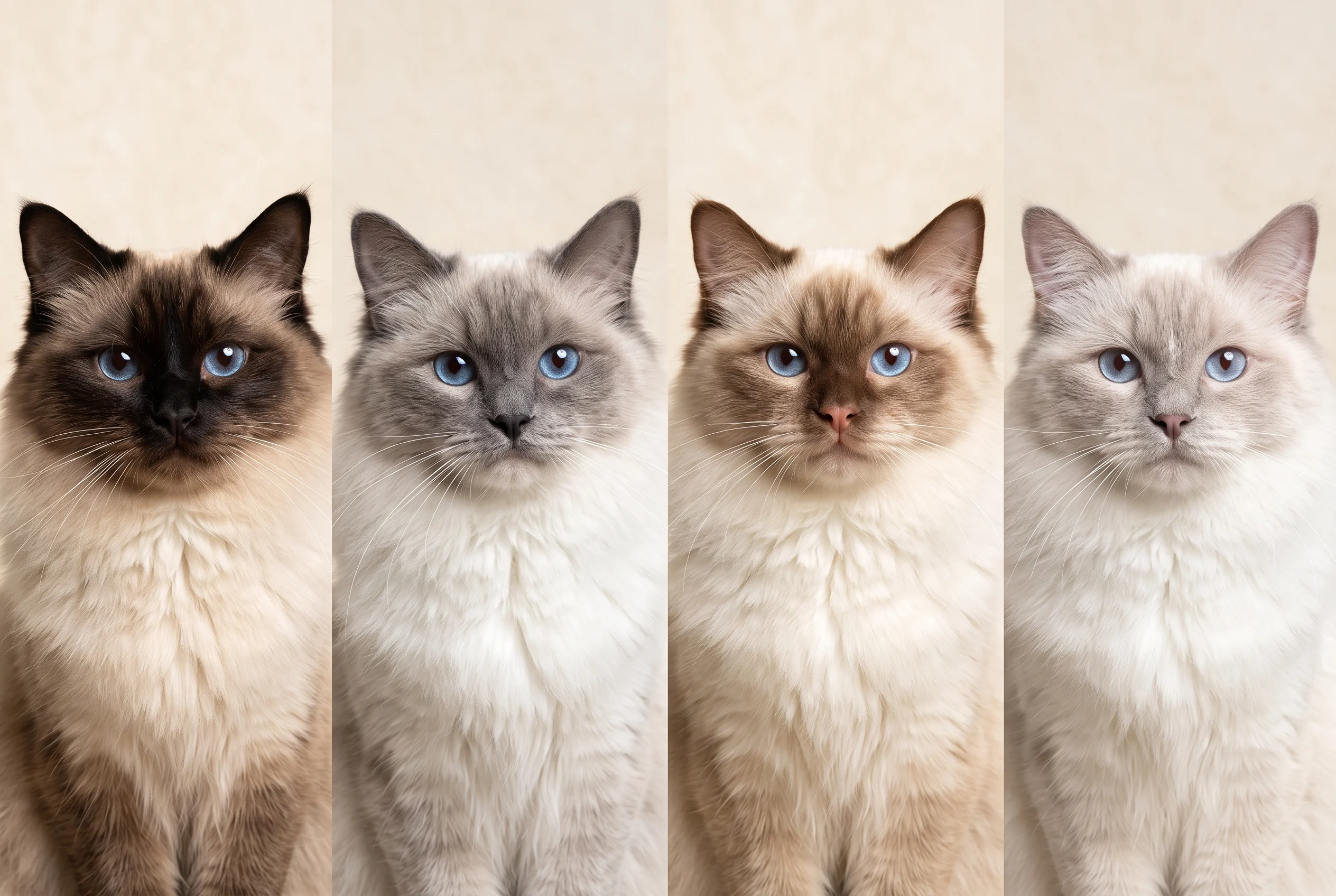
Chocolate Ragdolls have warmer, lighter brown points than seal Ragdolls, usually against an ivory-colored body. The difference between a dark seal kitten and a chocolate kitten can be subtle early on. Parentage and pedigree information can be helpful when identifying a kitten’s color.
4. Lilac Ragdoll: pale, frosty gray with a pink tone
Lilac is a very light, cool color, often described as frosty gray with a gentle pinkish cast. Lilac points are much paler than blue points, and the body is usually very light. The effect is delicate and understated, especially on a bicolor or mitted Ragdoll.
5. Red Ragdoll: warm apricot or orange tones
Red, sometimes informally called flame, brings warm apricot-to-reddish coloring to the points. These cats still have the Ragdoll’s pointed contrast and blue eyes. Red can also appear with lynx-style striping, so the precise description depends on the markings as well as the base color.
6. Cream Ragdoll: a gentle, pale warm color
Cream is the dilute version of red and appears as soft buff or pale peach-toned points. The markings may be subtle, particularly in young kittens. Cream Ragdolls can have the same bicolor, mitted, or colorpoint pattern distinctions as other colors.
What about cinnamon and fawn Ragdolls?
You may also encounter cinnamon and fawn in Ragdoll color guides. The International Cat Association (TICA) includes both in its description of Ragdoll colors. Cinnamon is a warm reddish-brown shade; fawn is its lighter, diluted counterpart. Recognition and terminology can vary between registries, so a breeder should be able to explain which standard applies to a kitten’s pedigree.
The important point is that a kitten’s base color is not the same as its white-marking pattern. A rare-sounding color label also does not, by itself, indicate better health, temperament, or quality.
The three main Ragdoll coat patterns
Colorpoint Ragdolls
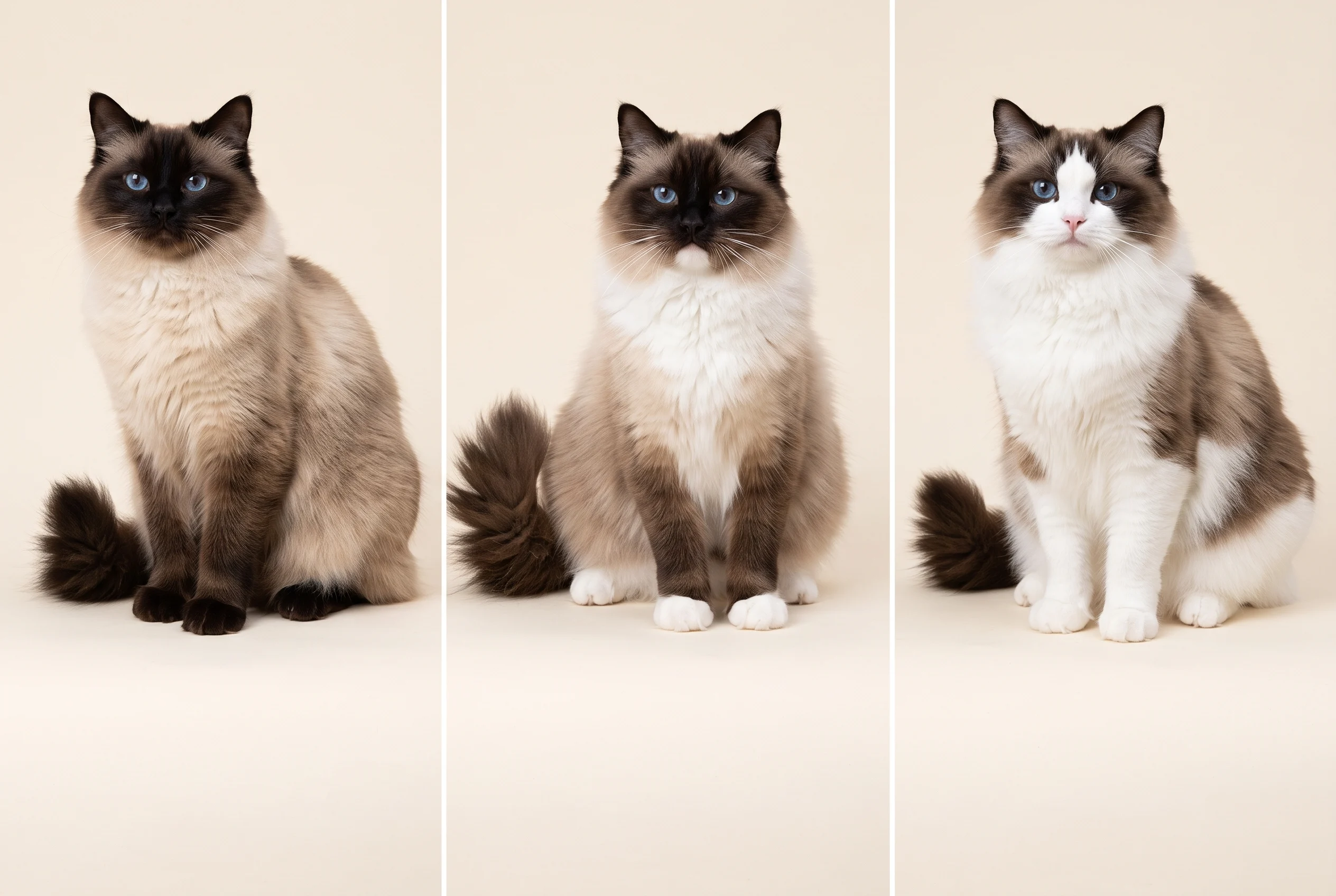
A colorpoint Ragdoll has darker pigment on the ears, mask, legs, feet, and tail, with no large white markings. The body remains lighter. Seal point and blue point are two familiar examples. Colorpoint describes the placement of color, not one particular shade.
Mitted Ragdolls
A mitted Ragdoll has the pointed coloring plus white front paws that resemble mittens, white back-leg boots, a white chin, and a white belly stripe. Some may have a small white blaze on the face. A blue mitted Ragdoll, for example, combines cool gray-blue points with those distinctive white markings.
Bicolor Ragdolls
A bicolor Ragdoll has more white than a mitted cat. Its best-known feature is a white inverted V on the face, with white on the chest, belly, and legs. The ears and tail retain the underlying point color. This is the pattern behind the popular Blue Bicolor and Seal Bicolor descriptions.
Some breed standards also describe a high-white or van variation. The exact classification of white distribution depends on the registry and the cat’s markings.
What do lynx and tortie mean?
Lynx refers to tabby-style striping in the colored points. A seal lynx Ragdoll may show stripes on the face, legs, and tail, rather than uniformly solid seal points. Lynx is a pattern variation, not a seventh base color.
Tortie, short for tortoiseshell, refers to a mix of point colors—often a darker base color intermingled with red or cream. A cat can have both tortie and lynx markings, sometimes called tortie-lynx. These terms describe appearance; they are not separate breeds.
Because coat color and pattern are different traits, names such as “blue lynx bicolor” or “seal tortie mitted” can sound complicated. Once you break them into their parts, they become much easier to understand.
Why do Ragdoll kittens change color as they grow?
Ragdoll kittens are typically born very pale, and their point coloring develops over the following weeks and months. This is a normal feature of the temperature-sensitive pigmentation associated with pointed coats. Cooler areas of the body—such as the ears, face, feet, and tail—develop more pigment than the warmer torso.
Markings may become easier to assess as a kitten grows, but a young kitten’s exact shade, white distribution, and eventual coat fullness should not be treated as a guarantee. The breed matures slowly, and point colors and body shading can continue changing into adulthood. Older Ragdolls may also appear darker than they did as kittens.
That is why we encourage families to look at updated photographs and the individual kitten’s profile rather than expecting a very young kitten to look exactly like an adult reference photo.
Blue Bicolor vs. Seal Bicolor: which should you choose?
Both have the classic bicolor white facial V, beautiful blue eyes, and the gentle companion-cat appeal for which Ragdolls are known. The most obvious difference is the point color: blue bicolors show cool slate-gray pigment, while seal bicolors show deeper warm brown pigment.
There is no reliable reason to expect a blue Ragdoll to be calmer or a seal Ragdoll to be more playful solely because of coat color. Temperament, socialization, health, and the fit with your household matter much more than which shade you prefer.
At SoCal Ragdolls, we recommend considering each kitten as an individual. Photos, date of birth, availability, and the information in the kitten’s profile are more useful than choosing on color alone.
Frequently asked questions about Ragdoll colors
Are all Ragdoll cats blue-eyed?
Traditional pointed Ragdolls recognized under the major pointed-breed standards have blue eyes. If you see a cat advertised as a Ragdoll with a different eye color or non-pointed coat, ask which registry and breed standard the breeder is using.
What is the difference between blue and lilac Ragdolls?
Blue points are a deeper cool slate-gray. Lilac points are much paler and often have a pinkish-gray cast. Both are distinct from seal’s dark brown coloring.
Is bicolor a color?
No. Bicolor is a white-marking pattern. A Ragdoll can be blue bicolor, seal bicolor, chocolate bicolor, or another permitted combination.
Do Ragdoll kittens stay the same color they are at eight weeks?
Not necessarily. Their point color typically develops and deepens over time, and adult coat density and shading can look different from early kitten photos.
Which Ragdoll color is best for families?
There is no universally best color. Choose a healthy, well-socialized kitten whose individual temperament and care needs suit your home. Coat color is a beautiful personal preference, not a measure of personality.
Discover your favorite Ragdoll in Southern California
Whether you love the cool elegance of a Blue Bicolor Ragdoll or the rich contrast of a Seal Bicolor, learning the difference between colors and patterns makes it easier to appreciate each kitten’s unique appearance. If you are looking for purebred Ragdoll kittens in Southern California, browse our current kittens and take a closer look at their individual photographs and profiles.